

Cleopatra - An Interesting Article

I've found this sometime ago on http://www.in70mm.com/ - I meant to post it here but a discussion elsewhere reminded me to:
Howard Terpning and Joseph L. Mankiewicz's “CLEOPATRA“ |
| Written by: Gerhard Witte, Berlin, Germany |
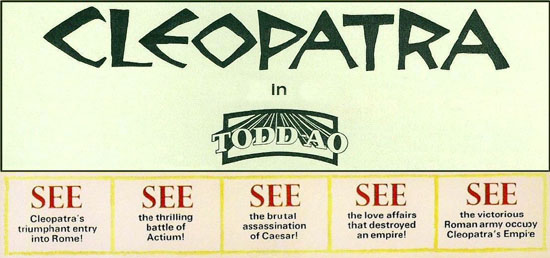 Howard Terpning is a painter and illustrator of our time. He is the most renowned and honored Western artist painting today. He also created some of the most memorable dramatic movie poster motifs between the years 1961 and 1974. Howard Terpning is a painter and illustrator of our time. He is the most renowned and honored Western artist painting today. He also created some of the most memorable dramatic movie poster motifs between the years 1961 and 1974.In this report I will take a look at the different “Cleopatra†(UK, USA, Switzerland, 1963) posters and the controversy surrounding the making of the famous poster art. Moreover, I give interesting information about Howard Terpning's life and about the film which started very successfully but then unfortunately did not perform as well as expected at the time. |
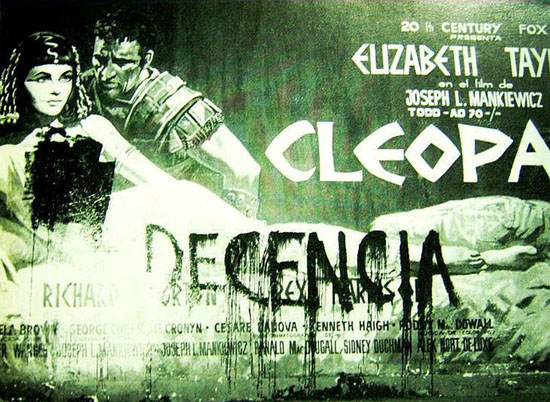 Image from “Film-Echo†(Scheuring / 1964) Image from “Film-Echo†(Scheuring / 1964)Astonishingly, in Spain at that time, the plunging neckline dress of Cleopatra (Elizabeth Taylor) incurred displeasure. The poster was found on a construction site fence in the centre of Barcelona, covered in black coal tar dye and with "Decencia" (translated "Decency") painted on it. So as not to offend moral sensibilities, also a slightly modified version of the motif was actually released in the 1960s. |
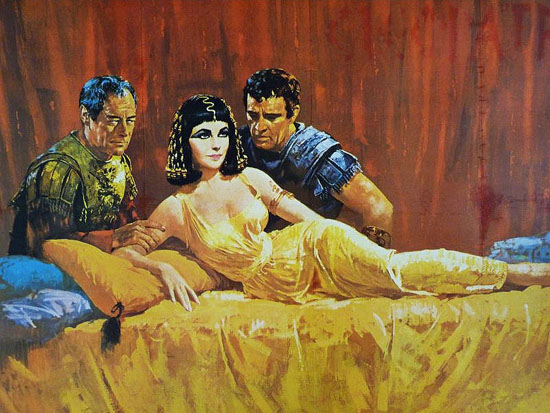 The poster, without any inscription, was mounted on canvas. I acquired it once in a London Gallery. The "displeasure" is now slightly softened in it. Maybe it also was shown for the European premiere of the film in London on 31 July 1963 at the Dominion Theatre on 268-269 Tottenham Court Road. In advance, the film's world premiere was on 12 June 1963 at the New York Rivoli Theatre on 1620 Broadway at 49th Street. The poster, without any inscription, was mounted on canvas. I acquired it once in a London Gallery. The "displeasure" is now slightly softened in it. Maybe it also was shown for the European premiere of the film in London on 31 July 1963 at the Dominion Theatre on 268-269 Tottenham Court Road. In advance, the film's world premiere was on 12 June 1963 at the New York Rivoli Theatre on 1620 Broadway at 49th Street.On 14th April 2011 an auction took place in Los Angeles (CA, USA). On this occasion it was reported: The original "Cleopatra" film poster art, one of the most “infamous†publicity paintings at that time, is set to be auctioned off by Profiles in History on May 14 and 15 at the Saban Theater in Beverly Hills, CA. |
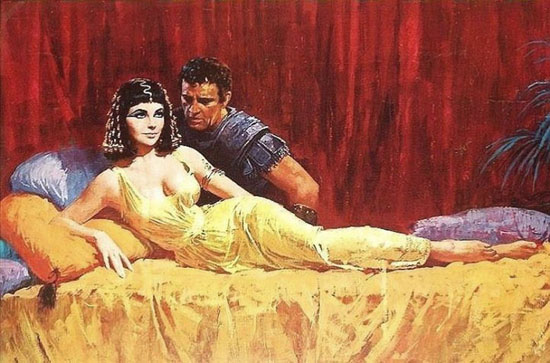 Here the very first version of Howard Terpning's poster art without Julius Caesar (Rex Harrison) Here the very first version of Howard Terpning's poster art without Julius Caesar (Rex Harrison)This acrylic painting, created on illustration board measuring 30" x 40" by the famed artist Howard Terpning, served as the print model for the publicity material surrounding this proudly announced epic film. Rex Harrison, one of the top billed stars was upset to find himself left out of the piece. The original only depicted Richard Burton and Elizabeth Taylor in a seductive and romantic pose with the studio quite happy to parlay the publicity surrounding their courtship into press for the film. Harrison sued and won lawsuit against 20th Century Fox. |
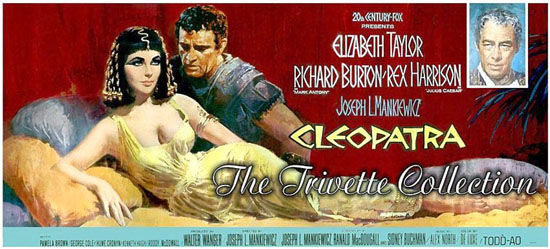 Consequently, Terpning was required by the studio to add Harrison into the design by enlarging and reworking his original painting, also forcing the studio to reprint all affected publicity material to correct this “oversightâ€. Consequently, Terpning was required by the studio to add Harrison into the design by enlarging and reworking his original painting, also forcing the studio to reprint all affected publicity material to correct this “oversightâ€. |
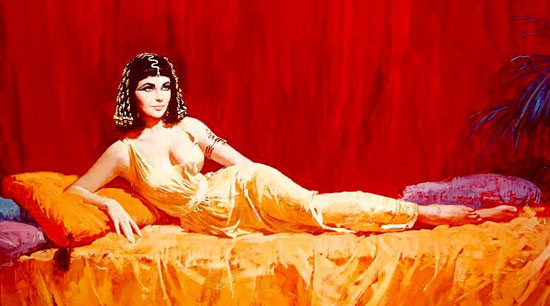 With the help of “computer magic“, also this version is possible – the seductive Egyptian Queen alone. You can find it on the internet with additional information. With the help of “computer magic“, also this version is possible – the seductive Egyptian Queen alone. You can find it on the internet with additional information.Howard Terpning has received numerous art-related awards, earning him a devoted following for his art outside of any Hollywood association. Routinely his paintings fetch several hundred thousand dollars at auctions. |
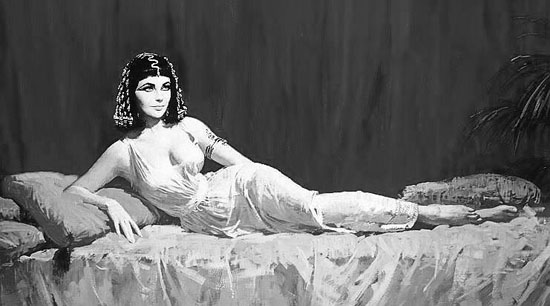 …and here in an also impressive rich in contrast black-and-white version …and here in an also impressive rich in contrast black-and-white versionFor instance, the famous painting with the reclining Cleopatra (Elizabeth Taylor) and her “leading†men, Julius Caesar (Rex Harrison) and Mark Antony (Richard Burton), was sold for $110,000 and a painting with the Queen enthroned alone brought $200,000 (Source: Mike Boehm, Los Angeles Times, May 17, 2012). Visit this informative web-site showing diverse "Cleopatra" film posters with its well-known motif and above all, of course, the wonderful “Trivette Collectionâ€. |
The Score |
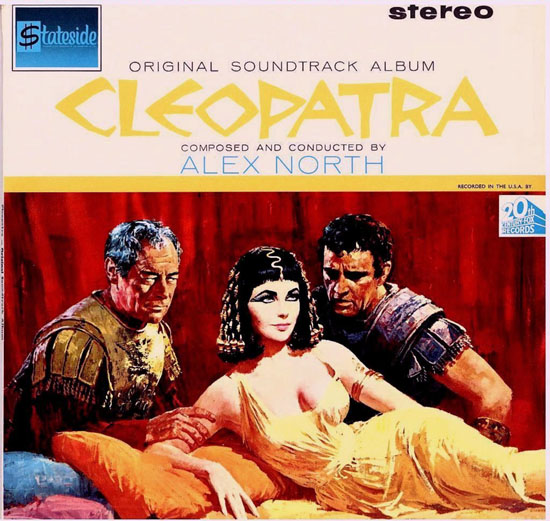 Soundtrack LP from the author´s collection Soundtrack LP from the author´s collection One week after the film's premiere in New York's VARIETY was written: “CLEO†ALBUM BARGES PAST 300,000 SALES The soundtrack album of “Cleopatra†on the 20th Century Fox label has now rolled over the 300,000 sales mark. Norman Weiser, diskery topper, reports that orders for 100,000 copies came in on Thursday, 13 June 1963 the day after the picture premiered at New York's Rivoli Theatre. The diskery started taking orders for the album before it was ready for the market and around 150,000 were taken by distributors on a cash guarantee basis. Another 50,000 were re-ordered before the film´s premiere. The soundtrack features the score by Alex North. |
Howard Terpning: A brief history of his career |
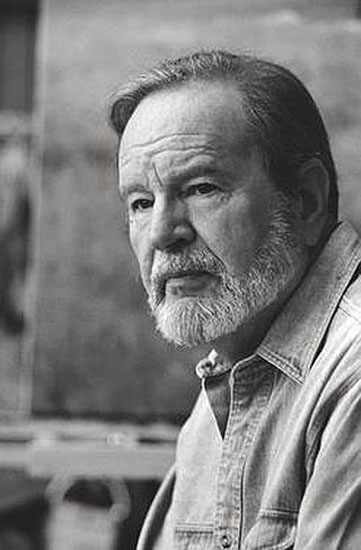 Picture from Western Art & Architecture on the internet Picture from Western Art & Architecture on the internet Howard Terpning saw the light of day on 5 November 1927. His place of birth is Oak Park, Illinois, USA - a western suburb of Chicago (also birthplace of Ernest Hemingway). As a young boy Howard was a passionate drawer and it is told that he already knew before his tenth year of life that he wanted to be an artist. After serving from 1945 to 1946, also as an infantryman in China, in the US Marine Corps, he studied at the Academy of Fine Art and then at the American Academy of Art life drawing and painting (both in Chicago). Later he moved to New York, the hub of advertising and magazine illustration. He gained first attention from some powerful covers of the magazines TIME and NEWSWEEK which he had designed. In the 60s Terpning became a prolific film poster artist for Hollywood and created some of the most memorable dramatic movie illustrations of the time. He worked as a commercial artist for twenty-five years, alone seventeen of them he lived in New York City. Besides his advertising art, he illustrated stories and articles for such publications as McCall's, Ladies Home Journal, Reader's Digest or Good Housekeeping. In 1967 he accepted an invitation from the Marine Corps to document Vietnam War scenes as a civilian combat artist. At the time he got a temporary rank of major to allow him relative freedom of movement and spent six weeks in Vietnam. Upon his return, Terpning created ten paintings that are now housed in the National Museum of the Marine Corps, at Quantico, Virginia, USA (Source: Mike Boehm, Los Angeles Times, May 17, 2012). Around 1975, Howard Terpning tossed aside a lucrative 25-year career as a commercial artist and decided to follow his interest in the American West and Native American traditions. “The American Indian fascinates meâ€, says Terpning. “The more I study them, the more intrigued I become. I have empathy for people who have struggled and had a hard life. I think it is important to tell the story of the Plains Indians because their history is our history - a part of our heritageâ€, says the artist, who also is member of the National Academy of Western Art (NAWA) and the Cowboy Artists of America (CAA). |
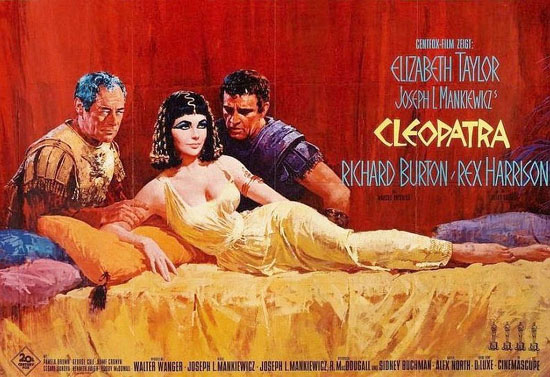 A German film poster with inscription. Cleopatra's plunging neckline dress is here also "corrected" - but only very slightly. A German film poster with inscription. Cleopatra's plunging neckline dress is here also "corrected" - but only very slightly.In 1977 he moved with his wife Marlies and his three children from Connecticut to Tuscon (Arizona) to become a famous western painter. Howard Terpning has a tremendous respect for the Native American people, portraying them honestly and accurately. A lot of Howard Terpning's original Western art oil paintings (not for films) now command top prices at Western auctions – few of them break the million dollar ceiling. For example in 2006 at the Coeur d´Alene Art Auction in Reno (Nevada, USA) his works: “Search for the Renegades†and “The Stragglers†found new homes for $1,456,000 and $1,064,000 respectively (Source: The Greenwich Workshop Catalogue). |
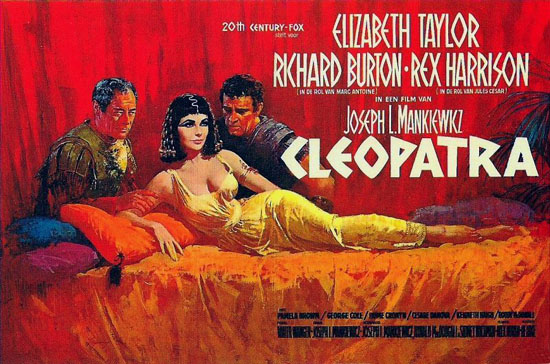 A Dutch poster of the epic film A Dutch poster of the epic filmThe Coeur d’Alene Art Auction has featured Western and American art for meanwhile 11 years in Reno and is the largest Western art auction in the country. From May 12 to July 01, 2012, he and his works were subject of a special exhibition at the Autry National Centre, Griffith Park, Los Angeles titled: Howard Terpning: Tribute to the Plains People. See the book: “Terpning: Tribute to the Plains People†page by page. He is honoured by numerous awards, which are too numerous to list here (see web-links at the end of the report to get more information). Use the following web-link to get a chronological list of the eighty five films for which Howard Terpning had designed movie illustrations between the years 1961 and 1974. Many thanks, Mr Terpning, for your wonderful unique movie poster arts you have created. You delight numerous film enthusiasts with your work around the world. |
Marketing of “Cleopatra†|
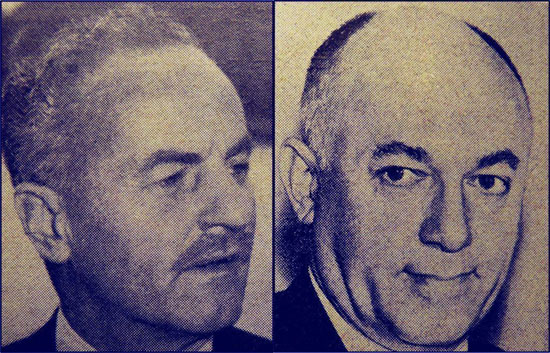 Images from “Filmblätter†/ April 1963 Images from “Filmblätter†/ April 1963Darryl F. Zanuck – filmmaking legend of Hollywood's Golden Age. In 1933 he was co-founder of 20th Century Pictures which merged with Fox Film Corporation on 31 May 1935. Both formed the famous newly founded film studio known as 20th Century Fox. With the arrival of television as competition in the early 50s Zanuck moved Fox to adapt CinemaScope to keep movies competitive. In 1962 he became President of 20th Century Fox. He retired in 1971, having produced numerous films during his career, such as “The Robe†(USA, 1953), “The King and I†(USA, 1956), “The Longest Day†(USA, 1962), “The Sound of Music†(USA, 1965), “Planet of the Apesâ€(USA, 1968) and “Hello, Dolly!†(USA, 1969). Seymour Poe – Vice President and at the same time total rental chef for 20th Century Fox in the 60s. He was Zanuck´s right-hand man in the rebuilding of 20th Century Fox from big problems to blooming prosperity. |
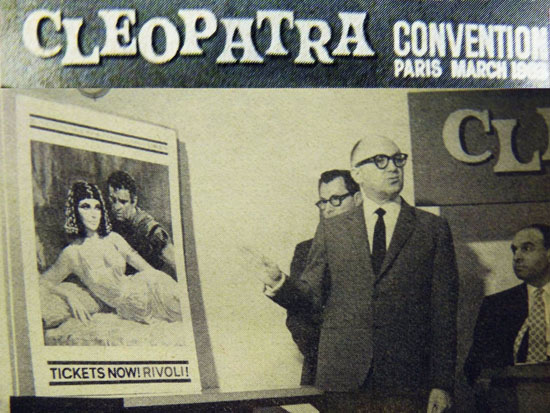 Seymour Poe, Vice President of 20th Century Fox, introduced delegates in March 1963 at the European Cleopatra Marketing Convention in Paris to the colossal promotional campaign which was planned for the 44-million-dollar Todd-AO film. The convention was attended by 43 representatives from 17 European countries including Great Britain (which would not join the EU until 1973) and the Middle East (Image from “Film-Echo†/ April 1963). Seymour Poe, Vice President of 20th Century Fox, introduced delegates in March 1963 at the European Cleopatra Marketing Convention in Paris to the colossal promotional campaign which was planned for the 44-million-dollar Todd-AO film. The convention was attended by 43 representatives from 17 European countries including Great Britain (which would not join the EU until 1973) and the Middle East (Image from “Film-Echo†/ April 1963).Already before its premiere CLEOPATRA broke all records. In Italy a license agreement had been concluded before the film premiered in the three cities of Rome, Milan and Naples. An advance payment of 120 million lire was paid – at the time in Italy the largest amount to get the right to show a film (Source: “La Cinématographie Francaiseâ€). |
 The business opportunities which the film offered did not go unnoticed. For instance, the publisher Alfred Klar from New York’s Program Publishing Company made a $350,000 advance payment to acquire the exclusive rights to produce and sell the film programme worldwide. Lavishly illustrated with colour photographs, the programme appeared in many countries and was translated into various languages. The business opportunities which the film offered did not go unnoticed. For instance, the publisher Alfred Klar from New York’s Program Publishing Company made a $350,000 advance payment to acquire the exclusive rights to produce and sell the film programme worldwide. Lavishly illustrated with colour photographs, the programme appeared in many countries and was translated into various languages. Also unusual at the time was the agreement between 20th Century Fox and the cinema in which the world premiere of the film was held, New York’s Rivoli Theatre. 150 days before the release of "CLEOPATRA", the cinema’s directors, believing all this inflated hype, made an advance payment of no less than 1.25 million dollars – then the largest sum ever paid for the premiere rights to a film. |
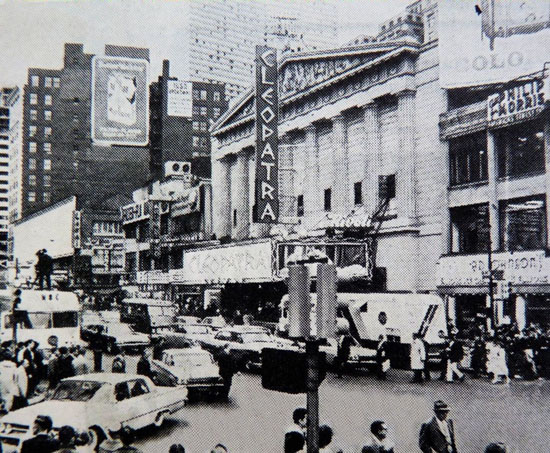 New York's Rivoli Theatre on afternoon of Cleopatra's world premiere on June 12, 1963 (Image from “Movie Marketing†/ June 1963). New York's Rivoli Theatre on afternoon of Cleopatra's world premiere on June 12, 1963 (Image from “Movie Marketing†/ June 1963).In the evening 10.000 New Yorkers jammed Broadway to watch VIPs arrive at the premiere of 20th Century Fox's film “Cleopatraâ€, the film industry's most expensive production at the time. The three major TV networks were on the spot with live coverage, and global reporters joined to give the event most international press coverage ever accorded a film premiere. Information about New York’s famous “road show theatre†and the premieres it hosted. |
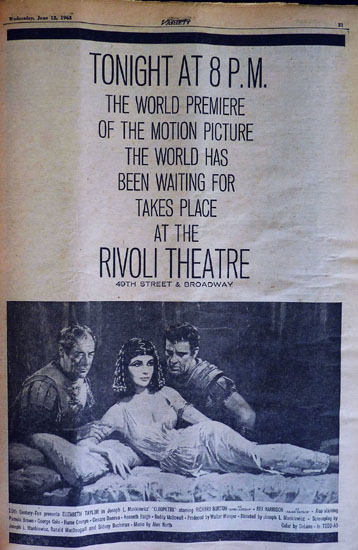 Full-page world premiere advert in New York's VARIETY Full-page world premiere advert in New York's VARIETYIn the first days the premieres were provided in many movie theatres as charity events with ticket prices up to 250 dollars. In Hollywood, Los Angeles, the film had its West Coast Premiere on 19 June 1963 at the RKO Pantages Theatre. According to information from VARIETY, all 1512 seats were sold at $ 250 each – at that time a record for fund-raising tied in with a film premiere. Information about the famous “road show theatre†in Los Angeles and the premieres it hosted. On 17 July 1963, 20th Century Fox made a public announcement with full-page adverts in newspapers: “To date, on 14 July 1963, the film CLEOPATRA is 51.5 % ahead of any other road show in the history of the business with no exceptions whatsoeverâ€. (Statement: At “road showsâ€, in this sense, new movies are premiered in selected theatres, mostly at higher ticket prices) During a New York press conference in spring 1964, Seymour Poe, Vice President of 20th Century Fox, informed participants that alone the rental fees for the film “Cleopatra†will make $ 55 million in the course of time. Up to the 15th of February 1964, the rental income already amounted to $ 14.2 million, ticket sales $ 25.9 million (Source: “Filmblätterâ€). "CLEOPATRA" received nine Oscar nominations and won four in 1964 - for Best Cinematography, for Best Art Direction (Set Decoration), for Best Costume Design and for Best Effects (Special Visual Effects). |
Premieres of the film in Europe |
Premiere in Great Britain |
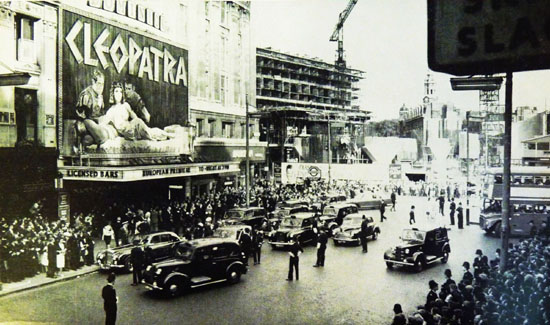 The well-known London Dominion Theatre at the festive European premiere of “Cleopatra†on 31 July 1963 (Image from “Film-Echo†/ August 1963). The well-known London Dominion Theatre at the festive European premiere of “Cleopatra†on 31 July 1963 (Image from “Film-Echo†/ August 1963).The Dominion Theatre, located in London's West End was selected to premiere the new Todd-AO process in the UK. "South Pacific" (USA, 1958) inaugurated the new roadshow policy on 21 April 1958 (European premiere) and racked up the longest ever run in a British cinema of 4 years, 5 months and 12 days, closing on 30 September 1962. In70mm.com reports that there were used two "South Pacific" 70mm prints with one print shown more than 1382 times between 1958-1962. At that time the theatre had a screen size of 46 x 21 ft with a 5 ft curve (measured across the curve - source: in70mm.com). For film performances seating came down to 1,654 with the upper gallery being curtained off. The Dominion was in trouble when Hollywood reduced making “big-budget extravaganzas†- also due to the fact that road show premieres moved to newly built cinemas. For balancing live shows were shown between the films. At present, the theatre only finds application for live shows. |
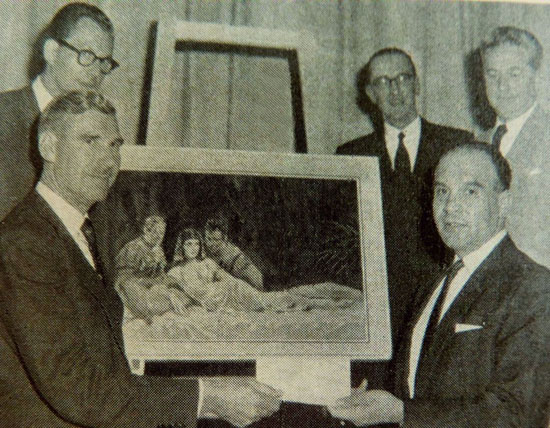 From bottom left to right: Kenneth Winckles, Director of Rank Organization, hands over a check of 300,000 British pounds (GBP) to Percy Livingstone, Director General of 20th Century Fox in London. From top left to right: Fred Hift, Advertising-Publicity-Director of 20th Century Fox in Great Britain, Europe and the Middle East, Gordon Hill, Secretary General of 20th Century Fox and Elmo Williams, Production-Director of 20th Century Fox in Europe (Image from “La Cinématographie Francaise†/ June 1963). From bottom left to right: Kenneth Winckles, Director of Rank Organization, hands over a check of 300,000 British pounds (GBP) to Percy Livingstone, Director General of 20th Century Fox in London. From top left to right: Fred Hift, Advertising-Publicity-Director of 20th Century Fox in Great Britain, Europe and the Middle East, Gordon Hill, Secretary General of 20th Century Fox and Elmo Williams, Production-Director of 20th Century Fox in Europe (Image from “La Cinématographie Francaise†/ June 1963).Prior to "Cleopatra"'s premiere, Rank Organization made an advance payment of 300,000 British pounds (GBP) to 20th Century Fox in order to be able to show the film at the London Dominion Theatre. |
Premiere in France |
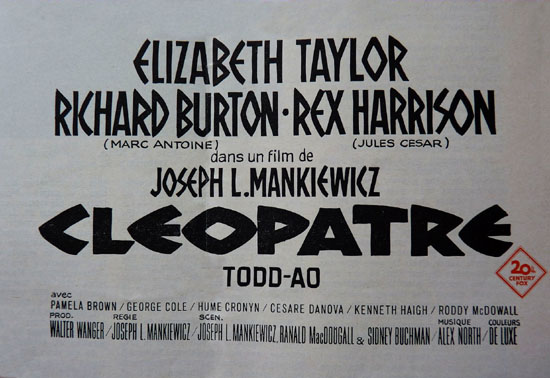 “Cleopatre†- la version française “Cleopatre†- la version françaiseIl a fallu deux mille ans pour que revive à l`écran toute la grandeur du règne de Cléopâtre. Il n`a pas fallu quarante-huit heures pour que plus de dix mille de Parisiens se précipitent pour aller voir le superspectacle de l`ecran CLEOPATRE!. En effet, après trois ans de tournage, CLEOPATRE! a fait sa sortie officielle sur les écrans parisiens le vendredi 25 octobre 1963, aux cinémas REX et LA ROTONDE en version française, et au NORMANDIE cinéma en version originale anglaise. (from “La Cinématographie Francaise†/ November 1963) |
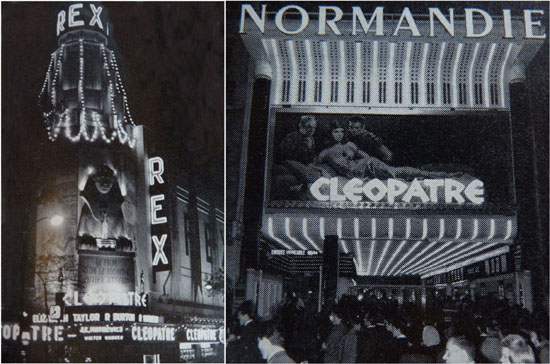 Premiere cinemas of “Cleopatra†in Paris: “Le Grand Rex†and “Normandie†Premiere cinemas of “Cleopatra†in Paris: “Le Grand Rex†and “Normandieâ€It lasted more than 2000 years to revive the greatness of Cleopatra's reign on the big screen. It lasted not even 48 hours that more than ten thousand Paris citizens saw the epic drama "CLEOPATRA" in cinemas at that time. |
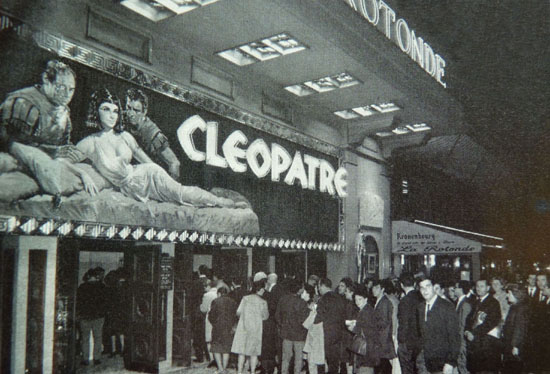 … and “La Rotonde†(Images from “La Cinématographie Francaise†/ November 1963). … and “La Rotonde†(Images from “La Cinématographie Francaise†/ November 1963).After three years of shooting, "CLEOPATRA" finally premiered on Friday, 25 October 1963 in three cinemas in Paris – at the cinemas REX and LA ROTONDE in the French version and at the NORMANDIE cinema in the original English version. |
Premiere in Germany |
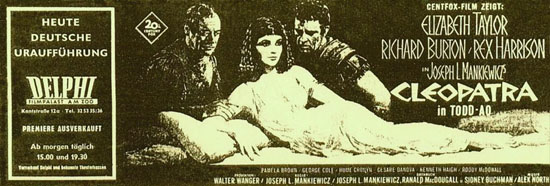 The German premiere of the film in Todd-AO was on Thursday, 24 October 1963 at the Berlin Delphi-Filmpalast am Zoo and also, most likely one day later, at the Düsseldorf Kristall-Palast. The German premiere of the film in Todd-AO was on Thursday, 24 October 1963 at the Berlin Delphi-Filmpalast am Zoo and also, most likely one day later, at the Düsseldorf Kristall-Palast.Premiere in Hamburg (also Germany) After the festive premiere at the Berlin Delphi cinema Gerhard Roger, I like his reviews, wrote the following about the film in the Berlin “Filmblätter": |
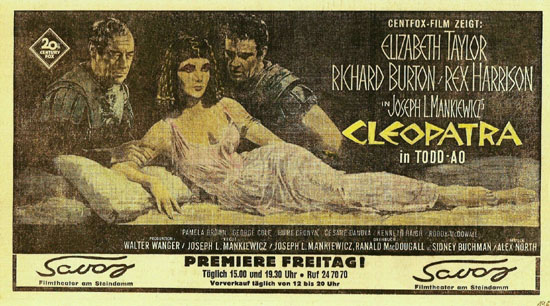 Advert for the North German premiere of the film on Friday, 3 January 1964 at the Hamburg Savoy-Filmtheater, where it subsequently ran for 26 weeks, until 2 July 1964 – the advert was additionally hand-coloured by me at the time. Advert for the North German premiere of the film on Friday, 3 January 1964 at the Hamburg Savoy-Filmtheater, where it subsequently ran for 26 weeks, until 2 July 1964 – the advert was additionally hand-coloured by me at the time.This took place exactly 2000 years ago: Trouble was brewing in the ruling clique of the Roman Empire. In the struggle between Republic, Dictatorship and Empire, the cunning Cleopatra sees and finds political opportunities. A refined beauty, she stirs up intrigue, confusion and a sense of turmoil from the Egyptian throne, finally emerging as a loving woman. |
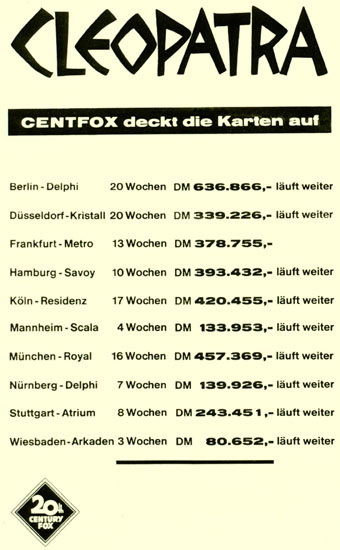 Box-office takings five months after the film´s premiere in various West German cinemas - including West Berlin. The German premiere theatre of the film, the revered West Berlin Delphi-Filmpalast am Zoo, tops all others at this time (Source: “Filmblätter†/ April 1964). Box-office takings five months after the film´s premiere in various West German cinemas - including West Berlin. The German premiere theatre of the film, the revered West Berlin Delphi-Filmpalast am Zoo, tops all others at this time (Source: “Filmblätter†/ April 1964)."Cleopatra" has not only inspired classical literature, but now also the American film. The latest version, which cost over 40 million dollars to make and has been widely quoted and gossiped about, is a large-scale, vast, shimmering and attractive spectacle. The crowd scenes, compositions (cross-fade from outdoor scenes to classic mosaics) as well as the individual performances of actors and technicians can, quite confidently, be regarded as cinematic milestones. The film is a massive and powerful depiction of Greek-Oriental Alexandria and classical Rome, yet Harrison's portrayal of a laid-back, mischievous Caesar has elements of an intimate play. The fanciful costumes and masks harmonise splendidly with Taylor's cosmetics and caprices, contrasted with Burton's vague and drunken Marc Antony. The spectacle sets a new benchmark in Hollywood colour technology and large-scale production. In its current length, the film offers considerable show value. However: For the Central European market, a clever script editor would cut out 30 to 40 minutes and make some changes to the dialogue to create a flawless, fascinating film. Nevertheless, the film captures the eyes and minds of the audience, and is the film that everyone is talking about. The greatest Hollywood film (to date). |
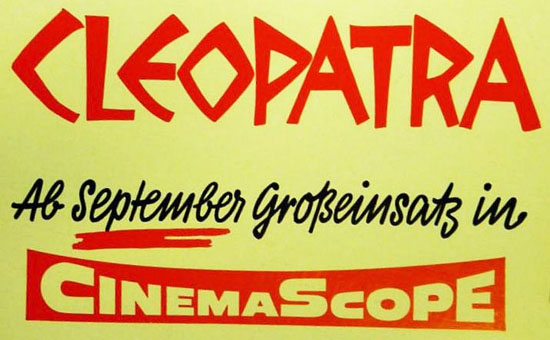 "Cleopatra" also in CinemaScope! (Source: “Filmblätter†/ April 1964) "Cleopatra" also in CinemaScope! (Source: “Filmblätter†/ April 1964)The four Oscar-winning movie "CLEOPATRA", shown with nine Todd-AO prints in West Germany, brought cinemas (including West Berlin) a revenue of several million D-Mark. Now, from September 1964, the film will also be available in German language in CinemaScope format. |
Premiere in Austria |
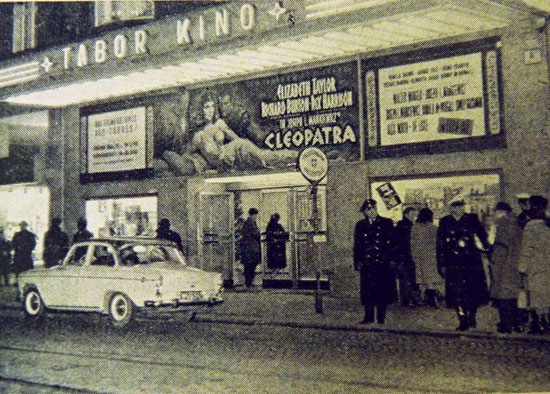 The Tabor Cinema in Vienna in the evening of Cleopatra's Todd-AO premiere on 22 January 1964. Long before the arrival of the celebrities police had kept the sidewalk clear. Curious people had to be content with a view from afar (Image from “Österreichische Film- und Kinozeitung†/ February 1964). The Tabor Cinema in Vienna in the evening of Cleopatra's Todd-AO premiere on 22 January 1964. Long before the arrival of the celebrities police had kept the sidewalk clear. Curious people had to be content with a view from afar (Image from “Österreichische Film- und Kinozeitung†/ February 1964).The Gala Premiere, organized by Metro-Goldwyn-Mayer Films Austria*, for the 20th Century Fox epic drama "Cleopatra" on the 22nd January 1964 at the Viennese Tabor Cinema (Tabor-Kino) was a major event on the social calendar of the city. Numerous celebrities from public life, members of the Austrian Government and the diplomatic corps and stars of stage and screen honoured the celebratory event with their presence. There were already thousands of curious onlookers in front of the festively decorated Tabor cinema hours before the show was due to start, both to admire the approach of the limousines and to lay siege to the cinema ticket office. *At the time, MGM Films distributed the films of both MGM and 20th Century Fox in Austria |
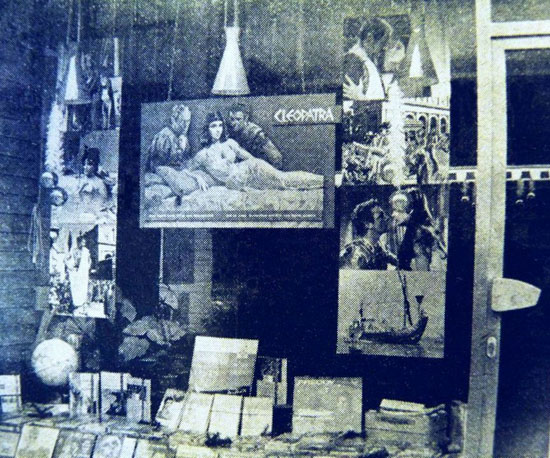 Numerous shops in Vienna, such as opticians, booksellers, perfumeries etc. had trimmed their windows for “Cleopatraâ€. The Egyptian queen is a brilliant eye-catcher, particularly because Liz Taylor is impersonating the queen (Image from “Österreichische Film- und Kinozeitung†/ February 1964). Numerous shops in Vienna, such as opticians, booksellers, perfumeries etc. had trimmed their windows for “Cleopatraâ€. The Egyptian queen is a brilliant eye-catcher, particularly because Liz Taylor is impersonating the queen (Image from “Österreichische Film- und Kinozeitung†/ February 1964).The Tabor Cinema (1916-1996) at 8 Taborstraße, formerly known as the Central-Kino (Central Cinema) / UFA-Tonkino (UFA |
0
Get In Touch

Comments
How about making a lecture on historical cleavage? I could handle the projector